

Payment processing is one of the few business costs that arrives as a percentage of everything you earn — and one of the few where most owners cannot say what they are actually paying. The statement does not make it easy, and that is not an accident.
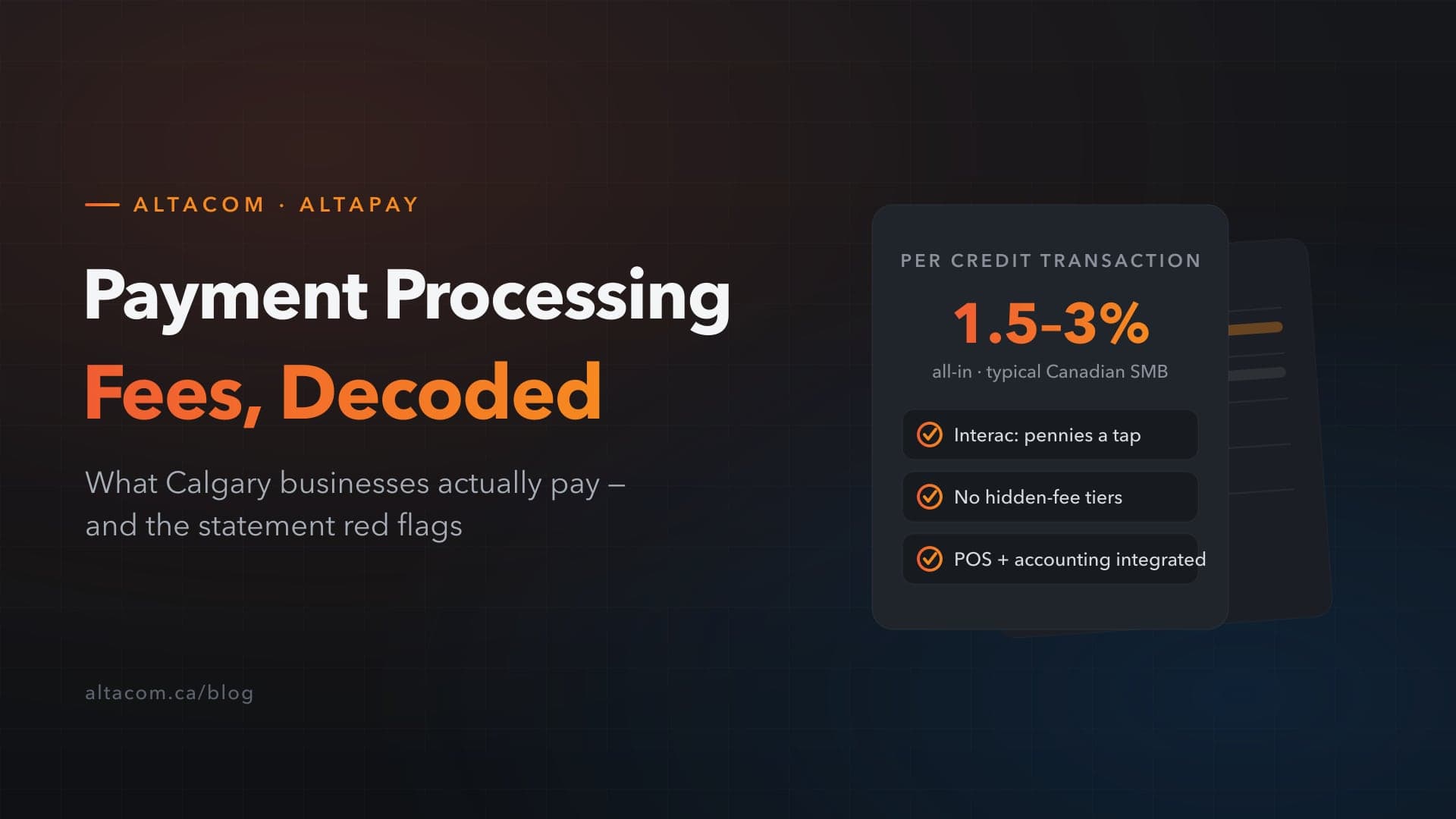
Most Calgary small businesses pay between 1.5% and 3% per credit card transaction, all-in. Where you land in that range depends almost entirely on which pricing model you are on and how much markup sits on top of the card networks’ base rates. Here is how to decode it.
The three pricing models, ranked by transparency
- Interchange-plus (most transparent). You pay the card networks’ published interchange rate plus a fixed processor markup — for example, "interchange + 0.3%". You can see exactly what the processor earns, and it is usually the cheapest model for established businesses.
- Flat rate (most predictable). One rate for every card — typically in the 2.6%–2.9% range plus a small per-transaction fee in Canada. Simple to budget, and often right for lower-volume businesses, but you overpay on debit-like low-cost cards.
- Tiered pricing (avoid). Transactions get sorted into "qualified", "mid-qualified", and "non-qualified" buckets at the processor’s discretion — and the advertised teaser rate applies only to the best bucket. If your statement uses these words, you are almost certainly overpaying.
What is actually inside the rate
Every credit transaction fee has three layers: interchange (set by Visa/Mastercard, goes to the issuing bank), network assessments (small, fixed by the card networks), and processor markup — the only layer that is negotiable. Canadian interchange also dropped for many small businesses under the federal agreement with Visa and Mastercard that took effect in late 2024; if your rate never moved after that, your processor kept the difference.
Canada’s quiet advantage: Interac debit
In-person Interac debit costs a flat few cents per transaction — not a percentage. For businesses with significant walk-in volume, every customer who taps debit instead of credit is meaningful margin. Terminal setup and prompts that make debit the easy default are one of the fastest payment savings available, and they cost nothing.
Five red flags on your current statement
- The words "qualified / non-qualified" anywhere — tiered pricing.
- A "PCI non-compliance fee" — you are being charged monthly for paperwork nobody helped you complete.
- Monthly minimums, statement fees, or "regulatory" fees that were not in the quote.
- A rate that never changed after the 2024 interchange reductions.
- An early-termination clause measured in years — transparent processors do not need to lock the door.
The part most businesses miss: integration
The fee percentage gets all the attention, but the hours lost to manual reconciliation are often the bigger cost. When your payment terminal, POS, and accounting system are integrated, every transaction lands in the right place automatically — no end-of-day matching, no keying errors, no month-end mystery variances. That is the difference between buying a terminal and building a payment system.
What AltaCom does differently
We start with a review, not a quote. We look at how your business actually takes payments — your transaction mix, average ticket, card-versus-debit split, and the POS, accounting, or ERP systems everything has to land in — and then at your current statement. That is usually enough to tell you within minutes which pricing model you are on and how much markup is sitting on top of interchange.
Then we take that volume to the market on your behalf. AltaCom is processor-agnostic: we compare Canadian processors on total cost rather than headline rates, negotiate the pricing, and recommend the one that fits how your business actually runs.
We will also be straight with you about our own economics. Steering you toward one over another earns us nothing. Getting the fit right earns us a client who stays, which is worth considerably more to us than any single deal. That is why our value here is advice rather than a product.
Once you choose, we handle the switch end to end: terminals configured so Interac debit is the easy default, PCI compliance built in rather than bolted on, and the whole thing integrated with your POS and accounting system so transactions reconcile themselves. Because the same team manages your IT, there is one number to call when something stops working. For businesses running storefronts, it fits alongside our retail technology solutions.
See how our payment processing service works — or book a free assessment and bring a recent processing statement. We will show you, line by line, what you are actually paying, where the savings are, and what a properly integrated setup would look like.