

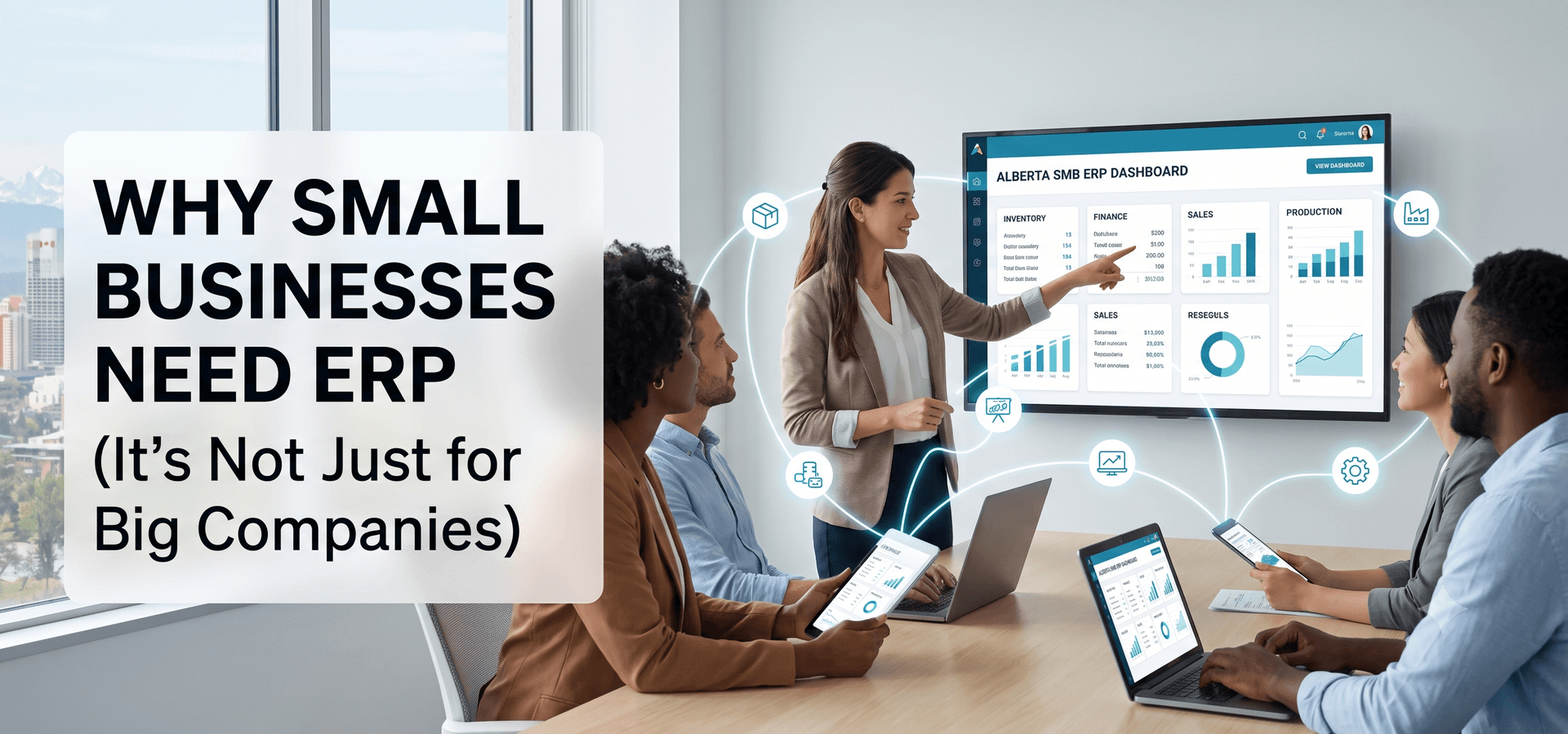
"ERP Is for the Big Guys" — and Other Reasons Small Businesses Keep Drowning in Spreadsheets
There's a moment most growing businesses hit without noticing.
It's the morning someone re-keys the same order for the third time — once in the quote, once in the accounting software, once in the spreadsheet that tracks what's actually been shipped. It's the invoice that went out wrong because two people were working from two different versions of the price list. It's the new hire who can't get a straight answer to "how many of these do we have left?" because the real answer lives in one person's head.
None of it is a crisis. That's the problem. It's just friction — small, daily, and quietly expensive. And almost every business that's outgrown its original tools is paying it.
When someone suggests the fix might be an ERP, the reaction is usually the same: that's enterprise software. That's for the big guys. We're not there yet.
It's worth unpacking that belief, because it's costing more than people think.
Where the "ERP is for big companies" idea comes from
The belief isn't irrational. For a long time, it was simply true.
Twenty years ago, an ERP system meant a million-dollar implementation, a dedicated IT department, a year of consultants, and software so complex you needed full-time staff just to run it. If you were a 25-person company, that world genuinely wasn't built for you. The advice to stay away was good advice.
That world is gone. The category didn't disappear — it changed shape. Modern ERP platforms are cloud-based, modular, and priced per user. You turn on the parts you need and ignore the rest. A business with 15 people can run one. The "you need to be big" assumption is a holdover from an era that ended, but the assumption stuck around longer than the reason for it did.
So the honest starting point is this: if you decided years ago that ERP wasn't for businesses your size, you were probably right then. It's just no longer the right conclusion.
What an ERP actually is, without the jargon
Strip away the acronym and the enterprise baggage, and ERP is a simple idea: one connected system instead of eight disconnected ones.
Most small businesses don't run on a single system. They run on a collection — accounting in one place, customer information in another, inventory in a spreadsheet, projects in someone's inbox, quotes in a Word template, and a few critical numbers that only exist in one employee's memory. Each tool works fine on its own. The problem is the gaps between them. Every gap is a place where information has to be copied by hand, where two versions of the truth can drift apart, and where a mistake can hide.
An ERP closes those gaps by putting the core of your business — sales, accounting, inventory, customers, operations — into one place that talks to itself. Enter something once, and it flows everywhere it needs to go. That's the whole concept. Everything else is detail.
It's less "enterprise software" and more "stop running your company on duct tape."
The signs you've already outgrown your setup
You don't need a consultant to tell you whether this applies to you. The symptoms are specific, and you'll recognize them immediately or you won't:
- The same information gets typed into more than one system, by hand, regularly.
- Someone spends a meaningful chunk of every week building reports by copying numbers between spreadsheets.
- A simple question — what's our actual margin, what's really in stock, which jobs are profitable — takes hours to answer, or gets a different answer depending on who you ask.
- One person is the only one who truly understands "the system," and you quietly worry about what happens when they're on vacation.
- Your tools were chosen one at a time as you grew, and none of them were chosen to work together.
If two or three of those land, you haven't been too small for ERP. You've been overdue for it and calling the problem something else.
What changes when it's working
The benefit isn't really about software. It's about what stops happening.
The re-keying stops, which means the errors that came from re-keying stop too. The arguments about whose number is right stop, because there's one number. The week no longer has a half-day of report-assembly built into it. New people get useful answers without interrupting a senior person to get them. And the business becomes legible — you can actually see what's selling, what's profitable, and where things are getting stuck, in close to real time instead of a month later.
The quiet one, the one owners mention most after the fact, is this: the business stops depending on a handful of people remembering how everything fits together. The knowledge moves out of heads and into a system. That's what makes a business easier to run, easier to grow, and frankly easier to one day sell.
The honest part: when you're not ready yet
ERP isn't the right move for everyone, and anyone who tells you otherwise is selling, not advising.
If you're a five-person shop, your current tools genuinely work, and nobody's wasting real time stitching them together — you don't need this yet. Putting an ERP on a business that doesn't have the friction to justify it just adds cost and complexity you'll resent. The trigger isn't a headcount or a revenue number. It's pain. When the cost of the friction — the wasted hours, the errors, the blind spots — clearly outweighs the cost and effort of fixing it, that's when it's time. Not before.
Being honest about that is the whole point. ERP is a tool for a specific problem. The question is never "are we big enough?" It's "is the disconnection actually hurting us?"
How to think about choosing one
Here's the mistake we see most often: businesses start by shopping for software. They look at platforms, compare feature lists, and try to figure out which product is "best."
That's backwards. The right starting point is your business, not the software. How do your operations actually run? Where's the friction? What would have to be true for a system to fit the way you already work, rather than forcing you to work the way the software wants? Get that clear first, and the platform decision gets much easier — and much less likely to end in an expensive system nobody uses.
There are several capable modern platforms that fit small and mid-sized businesses well. We work closely with Odoo because its modular, turn-on-what-you-need approach suits how Alberta SMBs actually grow — but the right answer genuinely depends on your business, and we'd rather understand yours before recommending anything.
The bottom line
"ERP is for the big guys" was true once. It isn't anymore. The category grew down to meet smaller businesses while the old reputation stayed put — which means a lot of capable, growing companies are still hand-stitching systems together and calling it normal, when a better option has quietly been within reach for years.
If the friction in this post sounds familiar, it's worth an honest conversation — not a sales pitch, just a look at whether your tools are still serving you or starting to hold you back.
Book a free assessment with AltaCom. We'll start with how your business actually runs, and tell you straight whether ERP is the right move — or whether you're better off where you are for now.
Common questions about ERP for small businesses
Is ERP only for large companies?
No — and that belief is mostly a holdover from the past. Twenty years ago, ERP meant million-dollar implementations that only large enterprises could justify, so staying away was sound advice for a small business. Modern ERP platforms are cloud-based, modular, and priced per user, which means a business with as few as 15 people can run one. The real question isn't whether you're big enough. It's whether running your business across disconnected tools is starting to cost you time and accuracy.
How do I know if my small business needs an ERP?
The clearest signal is friction you can name. The same information getting typed into more than one system by hand. Hours spent each week copying numbers between spreadsheets to build a report. Simple questions — what's our actual margin, what's really in stock — taking too long to answer, or getting different answers depending on who you ask. One person being the only one who truly understands how everything connects. If two or three of those sound familiar, you've likely outgrown your current setup, regardless of your headcount or revenue.
How much does ERP cost for a small business?
Modern ERP is usually priced as a per-user monthly subscription, with a separate one-time cost to implement it — configuring the system around how your business actually works. Total cost varies widely based on which modules you turn on, how many users you have, and how much customization you need, which is exactly why a proper assessment should come before any number. The honest way to judge it: ERP should pay for itself by removing the friction that's costing you time and errors today. If it can't, it isn't the right move yet.
AltaCom is a Calgary-based Managed IT, Cybersecurity, and ERP consulting partner serving Alberta businesses since 2011. We're vendor-agnostic by design: we understand your operations first, then recommend the platform that fits.